Presented by Lubrizol
Join us live Tuesday, October 24, 2017 at 11AM EDT (New York)
Estane TPU provides exceptional performance for surface protection applications, backed by more than 30 years of experience in the harshest environments. Road salt, flying stones, acid rain, and extreme hot and cold to name a few!
More recently, Estane TPU (thermoplastic polyurethane) has been introduced for use in demanding graphics applications, such as transportation wraps, building signage, and durable labels.
Whether you’re an OEM or polymer processor, Lubrizol’s Estane® TPU solutions for surface protection and graphics applications are there for you.
Applications:
Paint Protection (PPF)
Automotive Interiors
Graphics Media and Laminates
Signage and Labels
Consumer Products
Flooring
Architectural
Benefits:
Protecting surfaces from damage by impact and abrasion
Resistant to the effects of environmental exposure – color stability when exposed to UV
Low-temperature flexibility for wider range of installation conditions
Plasticizer-free – won’t embrittle over time
Join Peter Kirk, Marketing Manager, and Mark Cox, Applications Development Scientist, of Lubrizol’s Engineered Polymers business to learn more about Estane TPUs high performance solutions for graphics and surface protection applications.
About Lubrizol Engineered Polymers
Lubrizol Engineered Polymers offers one of the broadest portfolios of engineered polymers available today including resins that are bio-based*, recyclable**, light stable, flame retardant, adhesive, chemically resistant, optically clear and fast cycling. Our technology crosses many industries and applications, including surface protection, power and fluid systems, sports and recreation, wearable devices, electronics and automotive. For more information, visit www.lubrizol.com/engineeredpolymers or contact engineeredpolymers@lubrizol.com.
Opportunities for Process Optimizations with New Silicone Adhesives
Presented by Dow Advanced Assembly Solutions Join us live Thursday, October 19, 2017 at 3PM CEST (Paris) 9AM EDT
When assembling electronics modules, manufacturers can optimize processes to reduce costs. The choice of adhesive can greatly impact those costs, through the energy use, process time and other factors. Learn about the less-obvious ways that your choice of adhesives can make your process more efficient.
This webinar looks at the newest silicone adhesive technologies and how they are providing more options to optimize your assembly processes. These innovations include Quick-in-Connect (QiC) adhesives, high “green strength” adhesives, Thermal Radical Cure™ adhesives, and the new fast low-temperature cure adhesive (Dow Corning® EA-6060 Adhesive).
The webinar will compare the new silicone adhesives with more-traditional options, discussing cure times, energy needed for curing (if any), adhesion profiles (robustness), pricing, “green strength,” and applications.
Learn more about:
• Quick-in-Connect Adhesives — reactive, hot-melt thermoplastic adhesives that react with moisture to become thermosetting polymers with enhanced physical properties
• Thermal Radical Cure™ Adhesives — a revolutionary “inside out” cure technology provides a rapid, low-temperature cure in just a few minutes, with less sensitivity to oil and contaminants, low/no voiding, and durable adhesion to a wider variety of substrates
• Fast Low-Temperature Cure Adhesives — silicone adhesives that develop robust adhesion at temperatures as low as 80 °C in minutes
This webinar is for manufacturers and designers of a broad range of electronic assembly applications — from automotive electronics to battery packs, communication devices, lamps and luminaires and more. The webinar features Dow’s Florian Damrath, Technical Service & Development Expert, Advanced Assembly Solutions Europe.
While more and more cars are becoming electric, they are still essentially made from metal and conventional engineering plastics. Carbon and aluminium are lightweight, but use six times more energy to produce than steel, which goes some way to cancel out the energy they save in use after production. But researchers are driving innovation to biocomposite cars.
The idea of manufacturing a car from plants broke the headlines earlier this year when students from Eindhoven University in the Netherlands came up with a novel design and have begun to display it round the globe at a handful of high-profile events, including Dutch Technology Week and the Shell Eco marathon in London.
Flax is an interesting alternative. It grows everywhere and costs less energy to produce than aluminium and carbon, and it is a renewable material. What’s more, it is lightweight and can be recycled.
Flax has a very strong structure: when the fibres are stacked crosswise and compressed, panels made from it have a similar strength to carbon and aluminium, which are materials widely used in the car industry.
Meet Lina, the world’s first biocomposite car
Lina, a biocomposite car, and the honeycomb structure bioplastic that forms its foundation
Lina, the biocomposite car, features a complete chassis, the body of the car and the interior are all made of bio-based materials. The chassis is made of a combination of biocomposite and bioplastic. The honeycomb structure bioplastic, or PLA (polylactic acid), is a 100 percent biodegradable resin derived from sugar beet and supplied by a company called NatureWorks. It is enveloped in biocomposite sheets with a flax foundation. In terms of its strength-weight ratio, the biocomposite is comparable with familiar fibreglass composites but manufactured in a sustainable way. The bodywork is also flax-based.
EconCore’s ThermHex technology for cost-effective, continuous production of thermoplastic honeycomb core materials was used to manufacture the honeycomb based on PLA from NatureWorks.
ThermHex is a continuous process for the production of thermoplastic honeycombs integrated with in-line lamination of skin layers, by successive in-line operations, either directly from the extruder or from a roll of material. The versatile technology allows direct lamination of thermoplastic skins, as well as other facing layers (including, for instance, composites and metal) onto the thermoplastic honeycomb core to offer lightweight sandwich panels suitable for different applications.
The core is produced from a single sheet by a thermoforming, a folding and a bonding operation. ThermHex honeycombs have closed skin strips, allowing perfect bonding of skins onto the core. The process enables the cost-efficient production of honeycomb cores from a wide range of thermoplastic polymers with a large variation in cell size, density and thickness. In-line post-processing to panels and parts leads to further cost reductions.
The Lina is electric-powered and has a total weight of 300kg. Lina is certified by the Netherlands Vehicle Authority as roadworthy and can carry four people. It is a city car, reaching speeds up to 85km/hr. It only needs a licence plate before it can drive on public roads.
Prius lightens its load with biocomposite parts
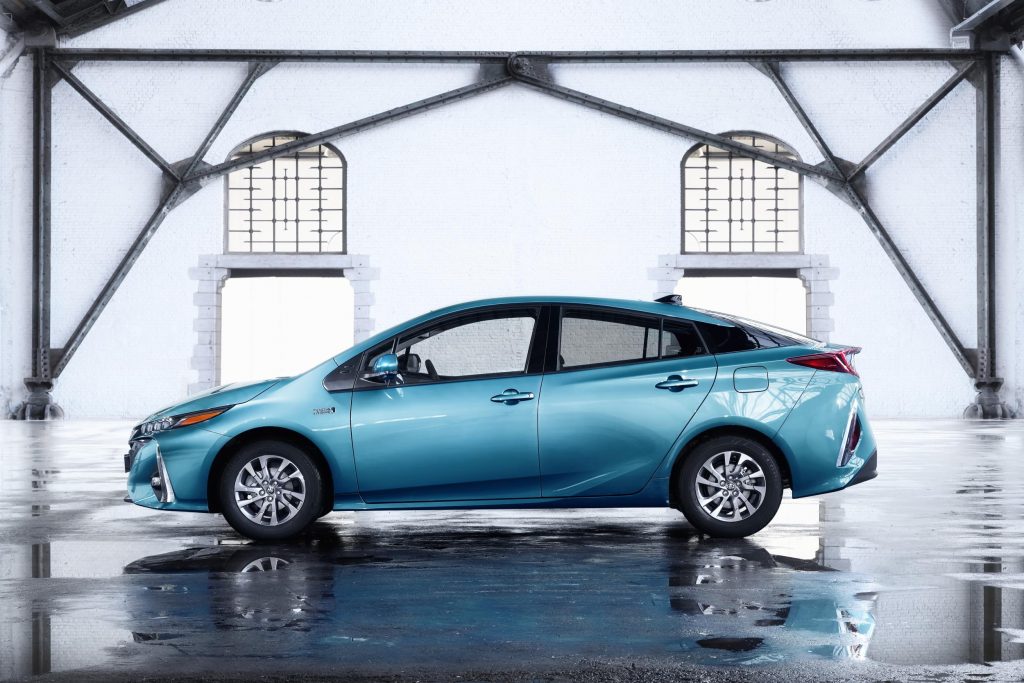
While the students have shown that it is possible to build a car from bio-based materials, it is unlikely the car industry will pick up the idea immediately. However, more conventional honeycomb materials are very much in the thinking of Japanese automotive OEM Toyota, which has adopted an interior part using honeycomb material for its new hybrid model Prius PHV launched earlier this year.
Toyota’s hybrid Prius PHV
The part is the boot (trunk) cover of the car. It was again achieved using ThermHex technology licensed from EconCore by Gifu Plastic Industry of Japan. Due to its combination of strength, rigidity and ultra-low weight, the honeycomb delivers weight savings of 50 percent compared to previous conventional material set-ups based on metal.
Prius boot/trunk with biocomposite materials
Gifu Plastic started to use the ThermHex process to make thermoplastic honeycomb products for packaging and logistics applications. Recently the company has extended to automotive interiors, where light, rigid and easy-to-thermoform honeycomb core materials have attracted interest in Europe and North America.
Folded honeycomb
The range of conventional engineering polymers suitable for use with ThermHex includes:
PP (Polypropylene)
PE (Polyethylene)
PS (Polystyrene)
PET (Polyethylene terephthalate)
PA (Polyamide)
PC (Polycarbonate)
ABS (Acrylonitrile-butadiene-styrene)
PPS (Polyphenylene sulfide)
PEI (Polyetherimide)
Due to the efficient process, the resulting sandwich panels are not only exceptionally strong and lightweight but also very cost-effective. EconCore has licensed the technology to several companies operating within packaging, automotive, furniture, building and transportation markets.
Boards are especially applicable to reusable plastic transportation boxes and solutions in the logistics sector, such as for durable and hygienic plastic pallets, and layer pads, dividers and protection panels, outperforming conventional corrugated plastic boards and PP cup shaped (bubble) panels.
Jochen Pflug, CEO of EconCore and inventor of the ThermHex technology says the efficiency of the patented continuous ThermHex process enables the naturally optimised honeycomb structure to be brought to more cost-sensitive applications, ultimately replacing heavier sub-optimal designs.
In combination with different skin materials, EconCore honeycombs offer a wide range of application possibilities. Low production costs enable other honeycomb cores and homogeneous panel materials to be substituted.
Sandwich panels with ThermHex honeycomb cores are especially suitable for automotive interior components, including:
luggage compartment floor and spare wheel covers
door panels / door inserts
seat back stiffeners and compartment dividers
cabin floor and underfloor systems
overhead systems (enhanced sound absorption with an open-cell honeycomb structure)
Continuously produced honeycomb sandwich panels offer opportunities in the transportation segment. Higher temperature resistant thermoplastic materials meet the needs of exterior applications, while fire-resistant materials are suited for mass transportation. Applications include:
delivery truck boxes
pick-up truck boxes
trailers
cladding panels in trucks
vans
trains
PET non-wovens may also be laminated onto the ThermHex core to enable processing with thermoset materials.
Global market disruptions such as increasing production capacity and feedstock availability has changed the downstream dynamics.
Whether you are a producer, trader or end-user, there is no exact formula to identify risk in making business decisions. Hence, it is important to grab every opportunity that will add value into your industry knowledge.
Join us in December as we deliver timely market insight and relevant product knowledge that will boost your competence as you navigate the industry’s complexity. Attend one or all of ICIS training courses on offer in London!
Essential events you shouldn’t miss:
Petrochemicals — An In-depth Introduction
4-5 December: This two-day course will enable you to understand the connection of petrochemicals with oil prices. Attending this course will give you across-the-board overview of the value chain Download the full agenda >>
Petrochemical Plant Economics and Forecasting
6 December: Take a closer look at the industry’s cost and profitability measures with this course. A day packed with information that will help you analyze the market conditions Download the full agenda >>
Fundamentals of the Polymers business
7-8 December: Our Polymer training course will focus on PE, PP, PVC, PS, ABS and PET markets. We will give a comprehensive overview of these commodities from processesing fundamentals to key supply & demand drivers Download the full agenda >>
BASF will build a new specialty amines plant at its existing wholly owned site in Nanjing Chemical Industry Park in China. The new multi-product plant can manufacture 21,000 metric tons per year and further extends BASF’s amines portfolio at the specialty amines complex in Nanjing.
Start-up Planned in 2019
BASF’s amines portfolio at the specialty amines complex in Nanjing
The plant is scheduled to come on stream in 2019 and will mainly produce 1,2-Propylenediamine (1,2-PDA), n-Octylamine (n-OA) and Polyetheramine (PEA).
“BASF offers a wide range of amines globally, and this investment reflects our continued commitment to meeting the growing market demand in Asia Pacific,” said Stefan Blank, President, BASF Intermediates division. “Building on decades of experience in developing and manufacturing amines, this new plant will further strengthen our global leadership in these versatile intermediate products.”
Increasing Asia Pacific Demand for Specialty Amines
“This investment will help us to meet the increasing Asia Pacific demand for specialty amines used as intermediates in a diverse range of industries and applications, such as epoxy formulations, crop protection agents, spandex and biocides for the coatings industry,” said Narayan Krishnamohan, Senior Vice President, Intermediates Asia Pacific, BASF. “Through this expansion, we will be able to better serve our customers in Asia Pacific with steady and timely supply of quality products.”
BASF also has manufacturing capacities for both 1,2-PDA and n-OA at its Ludwigshafen Verbund site in Germany. Manufacturing plants for PEA are located at BASF sites in Ludwigshafen, Germany, Geismar, USA and Nanjing, China.
The main products of the new plant include:
1,2-Propylendiamine (1,2-PDA) is an essential ingredient to produce elastic fibers. It is also used as a building block in the manufacture of pharmaceuticals, crop protection agents, colorants, textile auxiliaries, pigments and optical brighteners. Furthermore, it is used as a corrosion inhibitor in surface treatment products.
N-Octylamine (n-OA) is used as a chemical intermediate for the synthesis of antimicrobial and biocidal agents.
Polyetheramines (PEA) are chemical intermediates used, for example, to produce polyurea coatings, adhesives and plastics. PEA is also used as a curing agent in epoxy resin systems for the production of blades for wind energy plants. BASF offers PEA under its Baxxodur® brand.
Plasticizers are relatively non-volatile organic substances (mainly liquids). When incorporated into a plastic or elastomer, they help improve the polymer’s:
Flexibility
Extensibility and,
Processability
Plasticizers increase the flow and thermoplasticity of a polymer by decreasing the viscosity of the polymer melt, the glass transition temperature (Tg), the melting temperature (Tm) and the elastic modulus of the finished product without altering the fundamental chemical character of the plasticized material.
Use of Plasticizers
Plasticizers are among the most widely used additives in the plastic industry. They are also usually cheaper than other additives used in polymer processing.
Plasticizers are most often used in PVC, the third largest polymer by volume after PP and PE. In turn, PVC is used in a wide range of products. Examples include:
Unplasticized PVC (or rigid PVC) is used in applications such as pipes, siding, and window profiles.
Plasticized PVC (or flexible PVC) finds applications in automotive interior trim, cables, PVC films, flooring, roofing and wall coverings, etc.
However, a significant amount of plasticizers are also used in polymers like acrylics, PET, polyolefins, polyurethanes, etc. Plasticizers are also sometimes used in rubbers but in these cases they are used as extenders.
There are two main principal methods exist for plasticization:
Internal Plasticization
A polymer can be internally plasticized by chemically modifying the polymer or monomer so that the flexibility is increased. It involves copolymerization of the monomers of the desired polymer (having high Tg) and that of the plasticizer (having low Tg) so that the plasticizer is an integral part of the polymer chain. The most widely used internal plasticizer monomers are:
Vinyl acetate
Vinylidene chloride
But this technique is limited: every copolymer is only suited to certain flexibility requirements
Also, the complexity of the reaction can lead to longer reaction times and increased costs. Internally plasticized materials show temperature dependence and dimensional instability at high temperatures.
External Plasticization
This is the most commonly used method of plasticization because low cost liquid plasticizers give the formulator freedom in developing formulations for a range of products (from semi-rigid to highly flexible depending on the quantity). The most widely used external plasticizers include esters formed from the reaction of acids or acid anhydrides with alcohols. There are two main groups of external plasticizers:
A primary plasticizer enhances elongation, softness and flexibility of polymer. They are highly compatible with polymers and can be added in large quantities. For example: up to 50% of vinyl gloves are made up of plasticizers, which make the PVC flexible and soft enough to wear.
A secondary plasticizer is one that typically cannot be used as the sole plasticizer in a plasticized polymer. Secondary plasticizers may have limited compatibility with the polymer and/or high volatility. They may or may not contain functional groups which allow them to solvate the polymer at processing temperatures. Secondary plasticizers are variously used for:
Cost reduction
Viscosity reduction
Solvency enhancement
Surface lubricity augmentation, and
Low temperature property improvement
Extenders are a subset of secondary plasticizers. They are commonly employed with primary plasticizers to reduce costs in general purpose flexible PVC. They are mostly low cost oils having limited compatibility in PVC. They are added to reduce cost and in some cases to improve fire resistance. Examples of extenders include naphthenic hydrocarbons, aliphatic hydrocarbons, chlorinated paraffins (fire resistance) and others.
Processing with Plasticizers
Suspension PVC (S-PVC) Process is the common method to manufacture PVC:
PVC obtained in the form of particles with size 50-200 microns
Lower flexible PVC formula costs
PVC particles obtained are mixed with plasticizers & can be extruded in pellets which are further used for processing via extrusion, calendaring, injection molding…
Processing equipment is typically very expensive
Incorporation of an external plasticizer in PVC polymer enhances its flexibility. Addition of plasticizer chiefly involves five distinct steps:
Plasticizer mixed with resin
Plasticizer penetrates and swells the resin particles
Polar groups in the PVC resin are freed from each other
Plasticizer polar groups interact with the polar groups on the PVC chain
PVC structure is re-established Upon cooling, with full retention of plasticizer
Loss of Plasticizers Plasticizer Exudation
The incompatibility between polymer and plasticizer can cause exudation. There are several factors which can lead to migration of plasticizer out of plastics surface (or into or onto a substrate to which it is held in intimate contact) like temperature change, humidity change, mechanical stress, weathering, etc.
Loss of plasticizer can lead to less flexibility, embrittlement, and cracking.
Classification of Plasticizers
Plasticizers are commonly classified based on their chemical composition. It is possible to understand the influence of structural elements (e.g. different alcohols in a homologous series of phthalates, adipates, etc.) on the properties of plasticizers and their effect on base polymers.
Different plasticizers affect different physical and chemical properties of materials. Therefore, you need a particular plasticizer to change properties in a certain direction to meet requirements.
There are several general chemical families of plasticizers that are used for polymer modification. Among them, the most commonly used are:
Phthalate Esters– They are produced by esterification of phthalic anhydride or phthalic acid obtained by the oxidation of orthoxylene or naphthalene. Most commonly used phthalate plasticizers include:
DEHP: Low molecular weight ortho-phthalate. Still the world’s most widely used PVC plasticizer
DINP, DIDP: High molecular weight ortho-phthalates
Aliphatic dibasic acid Esters– These include chemicals such as glutarates, adipates, azelates and sebecates. They are made from aliphatic dibasic acids such as adipic acid and alcohols.
Benzoate Esters – They are esterification products of benzoic acid and selected alcohols or diols.
Trimellitate Esters – They are produced by esterification of trimellitic anhydride (TMA) and typically C8 – C10 alcohols
Polyesters – They are formed by the reaction of many combinations of dicarboxylic acids and difunctional alcohols.
Citrates – They are tetraesters, resulting from the reaction of one mole of citric acid with three moles of alcohol. Citric acid’s lone hydroxyl group is acetylated.
Bio-based Plasticizers – They are based on epoxidized soybean oil (ESBO), epoxidized linseed oil (ELO), castor oil, palm oil, other vegetable oils, starches, sugars etc.
Others – Includes Phosphates, Chlorinated Paraffins, Alkyl Sulfonic Acid Esters and more
When added to polymerresin, these plasticizers provide following benefits:
They make a product softer, improve flexibility
The processing becomes possible or easier
Plasticized products do not break easily at cold temperatures
Applications of Plasticizers
Over 90% of the plasticizers used in thermoplastic polymers are used in PVC. The plasticized polymer market and the plasticized PVC market are largely one and the same although some plasticizer is also used in acrylic polymers, polyurethanes, polystyrene even polyolefins.
Major end uses include:
Film and Sheeting
Products made from flexible PVCfilm and sheet include roofing membranes, geomembranes, upholstery, luggage, advertising signs, swimming pool liners and other.
Flexible PVC is a good electrical insulator with good processability and a useful service temperature range hence it is the perfect material for electrical applications such as insulation and jacketing for electrical conductors, insulation for fiber optic cables.
Coated Fabrics
PVC synthetic coated fabrics offer weather-resistance, and have excellent strength and durability. Used in industries which support architecture, lifestyle, sports, advertising, defense, mining, food & agriculture, automobiles and transportation. Products include tarpaulins, tents outdoor furniture and others
Other Applications of Flexible PVC:
Consumer goods — Apparel, footwear, packaging
Medical — Blood bags, IV tubing, biohazard containment structures, other medical devices
Non-PVC — Small amounts of PVC type plasticizers are used in other polymers including acrylics, polyurethanes, polystyrene
Most plasticized PVC products are durable goods, products with long service lives. Phthalates, because of their low volatilities, low water solubilities, good resistance to sunlight and temperature extremes, good compatibility with the PVC polymer and generally good resistance to biodegradation, are well suited for use in such products. Examples include:
Flexible PVC roofing membranes
Geomembranes
Wire and cable insulation
Phthalate plasticizers have been very difficult to replace in these end uses. Likewise, because of their relatively high solvating strength for the PVC polymer and relatively low viscosities, phthalate plasticizers have been found to be more easily processed in flexible PVC compounds as compared to at least some of the phthalate replacements.
Note however, that nearly half of the 7 million tons of plasticizer used annually is DEHP and DEHP, a general purpose type plasticizer, can be replaced in many products.