Presented by Lubrizol
Join us live Tuesday, October 24, 2017 at 11AM EDT (New York)
Estane TPU provides exceptional performance for surface protection applications, backed by more than 30 years of experience in the harshest environments. Road salt, flying stones, acid rain, and extreme hot and cold to name a few!
More recently, Estane TPU (thermoplastic polyurethane) has been introduced for use in demanding graphics applications, such as transportation wraps, building signage, and durable labels.
Whether you’re an OEM or polymer processor, Lubrizol’s Estane® TPU solutions for surface protection and graphics applications are there for you.
Applications:
Paint Protection (PPF)
Automotive Interiors
Graphics Media and Laminates
Signage and Labels
Consumer Products
Flooring
Architectural
Benefits:
Protecting surfaces from damage by impact and abrasion
Resistant to the effects of environmental exposure – color stability when exposed to UV
Low-temperature flexibility for wider range of installation conditions
Plasticizer-free – won’t embrittle over time
Join Peter Kirk, Marketing Manager, and Mark Cox, Applications Development Scientist, of Lubrizol’s Engineered Polymers business to learn more about Estane TPUs high performance solutions for graphics and surface protection applications.
About Lubrizol Engineered Polymers
Lubrizol Engineered Polymers offers one of the broadest portfolios of engineered polymers available today including resins that are bio-based*, recyclable**, light stable, flame retardant, adhesive, chemically resistant, optically clear and fast cycling. Our technology crosses many industries and applications, including surface protection, power and fluid systems, sports and recreation, wearable devices, electronics and automotive. For more information, visit www.lubrizol.com/engineeredpolymers or contact engineeredpolymers@lubrizol.com.
Opportunities for Process Optimizations with New Silicone Adhesives
Presented by Dow Advanced Assembly Solutions Join us live Thursday, October 19, 2017 at 3PM CEST (Paris) 9AM EDT
When assembling electronics modules, manufacturers can optimize processes to reduce costs. The choice of adhesive can greatly impact those costs, through the energy use, process time and other factors. Learn about the less-obvious ways that your choice of adhesives can make your process more efficient.
This webinar looks at the newest silicone adhesive technologies and how they are providing more options to optimize your assembly processes. These innovations include Quick-in-Connect (QiC) adhesives, high “green strength” adhesives, Thermal Radical Cure™ adhesives, and the new fast low-temperature cure adhesive (Dow Corning® EA-6060 Adhesive).
The webinar will compare the new silicone adhesives with more-traditional options, discussing cure times, energy needed for curing (if any), adhesion profiles (robustness), pricing, “green strength,” and applications.
Learn more about:
• Quick-in-Connect Adhesives — reactive, hot-melt thermoplastic adhesives that react with moisture to become thermosetting polymers with enhanced physical properties
• Thermal Radical Cure™ Adhesives — a revolutionary “inside out” cure technology provides a rapid, low-temperature cure in just a few minutes, with less sensitivity to oil and contaminants, low/no voiding, and durable adhesion to a wider variety of substrates
• Fast Low-Temperature Cure Adhesives — silicone adhesives that develop robust adhesion at temperatures as low as 80 °C in minutes
This webinar is for manufacturers and designers of a broad range of electronic assembly applications — from automotive electronics to battery packs, communication devices, lamps and luminaires and more. The webinar features Dow’s Florian Damrath, Technical Service & Development Expert, Advanced Assembly Solutions Europe.
While more and more cars are becoming electric, they are still essentially made from metal and conventional engineering plastics. Carbon and aluminium are lightweight, but use six times more energy to produce than steel, which goes some way to cancel out the energy they save in use after production. But researchers are driving innovation to biocomposite cars.
The idea of manufacturing a car from plants broke the headlines earlier this year when students from Eindhoven University in the Netherlands came up with a novel design and have begun to display it round the globe at a handful of high-profile events, including Dutch Technology Week and the Shell Eco marathon in London.
Flax is an interesting alternative. It grows everywhere and costs less energy to produce than aluminium and carbon, and it is a renewable material. What’s more, it is lightweight and can be recycled.
Flax has a very strong structure: when the fibres are stacked crosswise and compressed, panels made from it have a similar strength to carbon and aluminium, which are materials widely used in the car industry.
Meet Lina, the world’s first biocomposite car
Lina, a biocomposite car, and the honeycomb structure bioplastic that forms its foundation
Lina, the biocomposite car, features a complete chassis, the body of the car and the interior are all made of bio-based materials. The chassis is made of a combination of biocomposite and bioplastic. The honeycomb structure bioplastic, or PLA (polylactic acid), is a 100 percent biodegradable resin derived from sugar beet and supplied by a company called NatureWorks. It is enveloped in biocomposite sheets with a flax foundation. In terms of its strength-weight ratio, the biocomposite is comparable with familiar fibreglass composites but manufactured in a sustainable way. The bodywork is also flax-based.
EconCore’s ThermHex technology for cost-effective, continuous production of thermoplastic honeycomb core materials was used to manufacture the honeycomb based on PLA from NatureWorks.
ThermHex is a continuous process for the production of thermoplastic honeycombs integrated with in-line lamination of skin layers, by successive in-line operations, either directly from the extruder or from a roll of material. The versatile technology allows direct lamination of thermoplastic skins, as well as other facing layers (including, for instance, composites and metal) onto the thermoplastic honeycomb core to offer lightweight sandwich panels suitable for different applications.
The core is produced from a single sheet by a thermoforming, a folding and a bonding operation. ThermHex honeycombs have closed skin strips, allowing perfect bonding of skins onto the core. The process enables the cost-efficient production of honeycomb cores from a wide range of thermoplastic polymers with a large variation in cell size, density and thickness. In-line post-processing to panels and parts leads to further cost reductions.
The Lina is electric-powered and has a total weight of 300kg. Lina is certified by the Netherlands Vehicle Authority as roadworthy and can carry four people. It is a city car, reaching speeds up to 85km/hr. It only needs a licence plate before it can drive on public roads.
Prius lightens its load with biocomposite parts
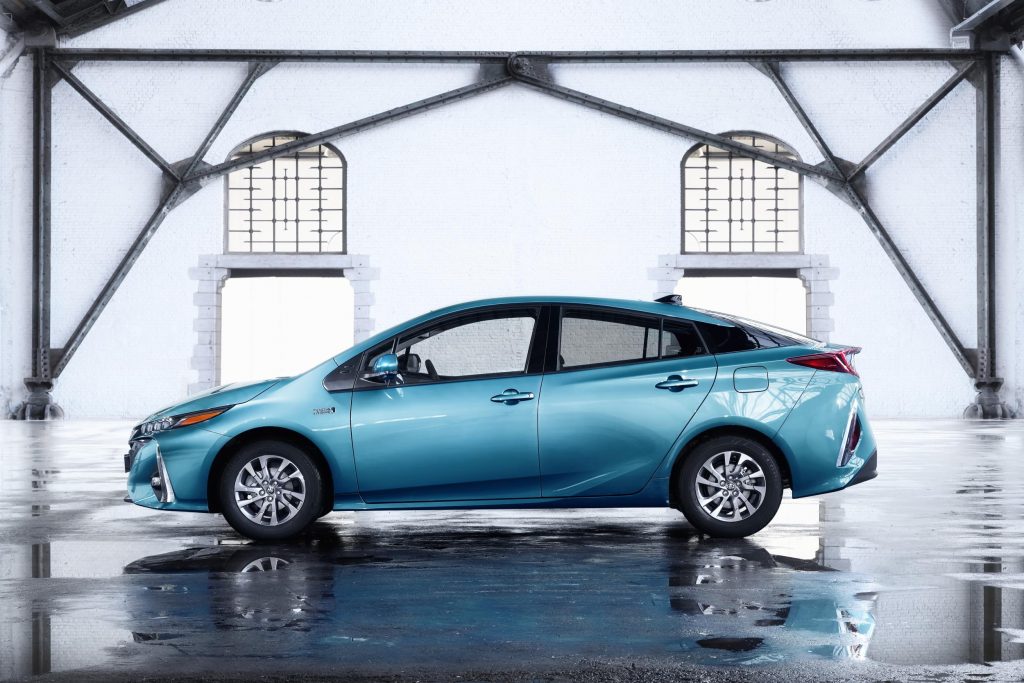
While the students have shown that it is possible to build a car from bio-based materials, it is unlikely the car industry will pick up the idea immediately. However, more conventional honeycomb materials are very much in the thinking of Japanese automotive OEM Toyota, which has adopted an interior part using honeycomb material for its new hybrid model Prius PHV launched earlier this year.
Toyota’s hybrid Prius PHV
The part is the boot (trunk) cover of the car. It was again achieved using ThermHex technology licensed from EconCore by Gifu Plastic Industry of Japan. Due to its combination of strength, rigidity and ultra-low weight, the honeycomb delivers weight savings of 50 percent compared to previous conventional material set-ups based on metal.
Prius boot/trunk with biocomposite materials
Gifu Plastic started to use the ThermHex process to make thermoplastic honeycomb products for packaging and logistics applications. Recently the company has extended to automotive interiors, where light, rigid and easy-to-thermoform honeycomb core materials have attracted interest in Europe and North America.
Folded honeycomb
The range of conventional engineering polymers suitable for use with ThermHex includes:
PP (Polypropylene)
PE (Polyethylene)
PS (Polystyrene)
PET (Polyethylene terephthalate)
PA (Polyamide)
PC (Polycarbonate)
ABS (Acrylonitrile-butadiene-styrene)
PPS (Polyphenylene sulfide)
PEI (Polyetherimide)
Due to the efficient process, the resulting sandwich panels are not only exceptionally strong and lightweight but also very cost-effective. EconCore has licensed the technology to several companies operating within packaging, automotive, furniture, building and transportation markets.
Boards are especially applicable to reusable plastic transportation boxes and solutions in the logistics sector, such as for durable and hygienic plastic pallets, and layer pads, dividers and protection panels, outperforming conventional corrugated plastic boards and PP cup shaped (bubble) panels.
Jochen Pflug, CEO of EconCore and inventor of the ThermHex technology says the efficiency of the patented continuous ThermHex process enables the naturally optimised honeycomb structure to be brought to more cost-sensitive applications, ultimately replacing heavier sub-optimal designs.
In combination with different skin materials, EconCore honeycombs offer a wide range of application possibilities. Low production costs enable other honeycomb cores and homogeneous panel materials to be substituted.
Sandwich panels with ThermHex honeycomb cores are especially suitable for automotive interior components, including:
luggage compartment floor and spare wheel covers
door panels / door inserts
seat back stiffeners and compartment dividers
cabin floor and underfloor systems
overhead systems (enhanced sound absorption with an open-cell honeycomb structure)
Continuously produced honeycomb sandwich panels offer opportunities in the transportation segment. Higher temperature resistant thermoplastic materials meet the needs of exterior applications, while fire-resistant materials are suited for mass transportation. Applications include:
delivery truck boxes
pick-up truck boxes
trailers
cladding panels in trucks
vans
trains
PET non-wovens may also be laminated onto the ThermHex core to enable processing with thermoset materials.
More than 1700 exhibitors will present their international offerings on the occasion of the 25th anniversary of the world’s leading technical event for industrial plastics processing. Fakuma will take place in the fully occupied Friedrichshafen Exhibition Centre from 17 to 21 October 2017, and is expecting more than 40,000 expert visitors from 120 countries.
Attention will be focused on the latest technologies which promise highly advantageous benefits, as well as processes and tools for efficient plastics processing by means of injection moulding, extrusion, thermoforming and 3D printing. Celebrate Fakuma!